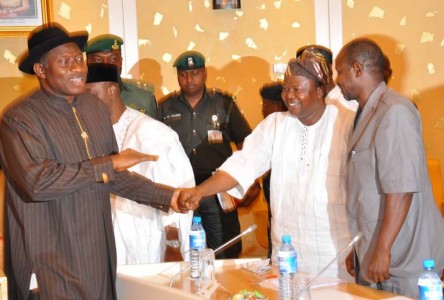
After a marathon 13-hour meeting between President Goodluck Jonathan
and the Academic Staff Union of Universities (ASUU), the union’s leader
said there was a message from the President which would be presented to
their members for consideration.
There are however indications that the meeting, which started at
about 2:40 p.m Monday afternoon and went on till aout 3:30 a.m Tuesday
morning, may have yielded positive results.
Monday’s meeting is the first time the president would lead
government’s delegation team for negotiation with ASUU since the
commencement of the strike four months ago.
The presidency had taken over the negotiation with the striking union
on September 20, with Vice President Namadi Sambo heading the
government team. He however was unable to make any headway in the talks
with the university teachers.
Emerging from the meeting at the First Lady’s conference room at the
presidential villa, ASUU President, Nasir Faggae said, “We have had
lengthy meeting with Mr. President, rubbing minds on how best to address
the problem of university education in this country.”
“We now have a message from Mr. President that we are going to take
to our members and we are expecting that our members will respond
appropriately to the message of Mr. President.”
On whether the lecturers are now going back to the classroom, the ASUU President said, “that is up to our members.”
When asked to disclose the the President ‘s message that would be
delivered to the members of the union, Mr. Faggae said, “I cannot tell
you, it’s not for you, it is for our members.”
On whether he was impressed with the President’s message, Mr. Faggae
said, “Don’t put words into my mouth, our members will determine that”
However, Labour Minister, Emeka Wogu told State House Correspondents
that meaningful progress was made in the negotiations with ASUU,
expressing hope that the striking lecturers would call off the strike.
Mr. Wogu said, “We made progress, the President of ASUU told you that
they are going back with a message from the Federal Government back to
their members and the message is full of high expectations and hope.”
On whether the strike would be called off, he said: “That is why the
message is full of high expectations and hope. So our prayers is that
they come back with positive outcome. They might not even come back to
meet us, they might take decisions there that will meet your
expectations.”
“Nigerians should be patient for ASUU to finish their meetings and come out with a message to Nigerians.”
Responding to whether the Federal Government made a fresh offer to
the striking lecturers, the Minister said, “the offer we made are the
offer they are taking in line with the 2009 agreement. The issues that
led to the strike are issues contained in the 2009 agreement and we did
not go beyond the agreement.”
About four hours into the meeting (6:30p.m. Monday) the meeting broke
for a 15-minute break. The ASUU President led his team to their bus, a
white Toyota Bus with Lagos registration number, BU 190 EPE, to confer
amongst themselves. While making the consultation, the ASUU leaders left
the leadership of the NLC, the TUC and government representatives back
at the hall.
The meeting resumed at about 6:50 p.m.
The ASUU President led members of the national leadership of the
academic union, including his deputy, Professor Biodun Ogunyemi, three
past presidents of ASUU, Professor Festus Iyayi, Professor Dipo Fashina
and Professor Abdullahi Sule-Kano.
Other members of ASUU delegation include Professor Suleiman Abdul, Professor Victor Osodeke and Dr. Victor Igbum.
The President of the Trade Union Congress (TUC), Bobboi Kaigama as
well as staff and other members of the congress were also at the
meeting.
On the side of government were Vice President Sambo; Secretary to the
Government of the Federation (SGF), Anyim Pius Anyim; Chief of Staff to
the President, Mike Oghiadhomhe; Minister of Finance, Ngozi
Okonjo-Iweala; her counterpart in the Labour and Productivity Ministry,
Emeka Wogu and the Supervising Minister of Education, Nyesom Wike.
Also at the meeting were the Permanent Secretary of the Federal
Ministry of Education, Dr. Mac John Nwaobiala; Executive Secretary,
National Universities Commission (NUC), Professor Julius Okojie and
Director, Tertiary Education in the Ministry of Education, Dr. Hindatu
Abdullahi.
Synopsis of the contentious 2009 agreement
The agreement included details such as the breakdown of lecturers’
salary structure, staff loans, pension, overtime, and moderation of
examinations.
Part of the agreement dwelt on funding of universities where both
parties agreed that each federal university should get at least N1.5
trillion between 2009 and 2011 while state universities, within the same
period, should receive N3.6 million per student.
The agreement also had parts that asked the re-negotiation committee
to ensure that at least 26 percent of Nigeria’s annual budget was
allocated to education, and half of that allocation to universities.
The agreement also asked that the 2004 Joint Admission and
Matriculation Board, JAMB, Act, and the National University Commission
Act 2004, be amended.
Text of the suggested amendment bills – including suggestion for
amendment of the Education (National Minimum Standards and Establishment
of Institutions) Act 2004 – were provided in the agreements.
The agreement was signed by Bolanle Babalakin, the then chairman of
Committee of Pro-Chancellors of Federal Universities; Gamaliel Onosode,
chairman of the re-negotiation committee; and Ukachukwu Awuzei, the then
president of ASUU.
The agreement demanded a heavy financial commitment from the
government and was an adaptation of an earlier agreement reached in
2001.
It is unclear how much of the agreement have been implemented by the government.
However, the secretary to the federation, Pius Anyim, after one of
the recent failed negotiations, said that most of the issues contained
in the 2009 agreement, had been fully met except for the earned
allowances estimated at N92 billion.
“Some of the issues which bothered on amendment of pensionable
retirement age of academics in the professorial cadre, consolidated
peculiar allowances (CONPUAA)- exclusively for university teaching
staff, National Health Insurance Scheme (NHIS), setting up of budget
monitoring committee in all public universities have been fully
implemented,” he disclosed.